Welcome to Admiral
Admiral (app.admrl.co) is an edge orchestration platform and immutable operating system designed for Autonomous Mobile Robots (AMRs), Automated Guided Vehicles (AGVs), Edge AI Nodes, Smart Kiosks, and Distributed Hardware Fleets.
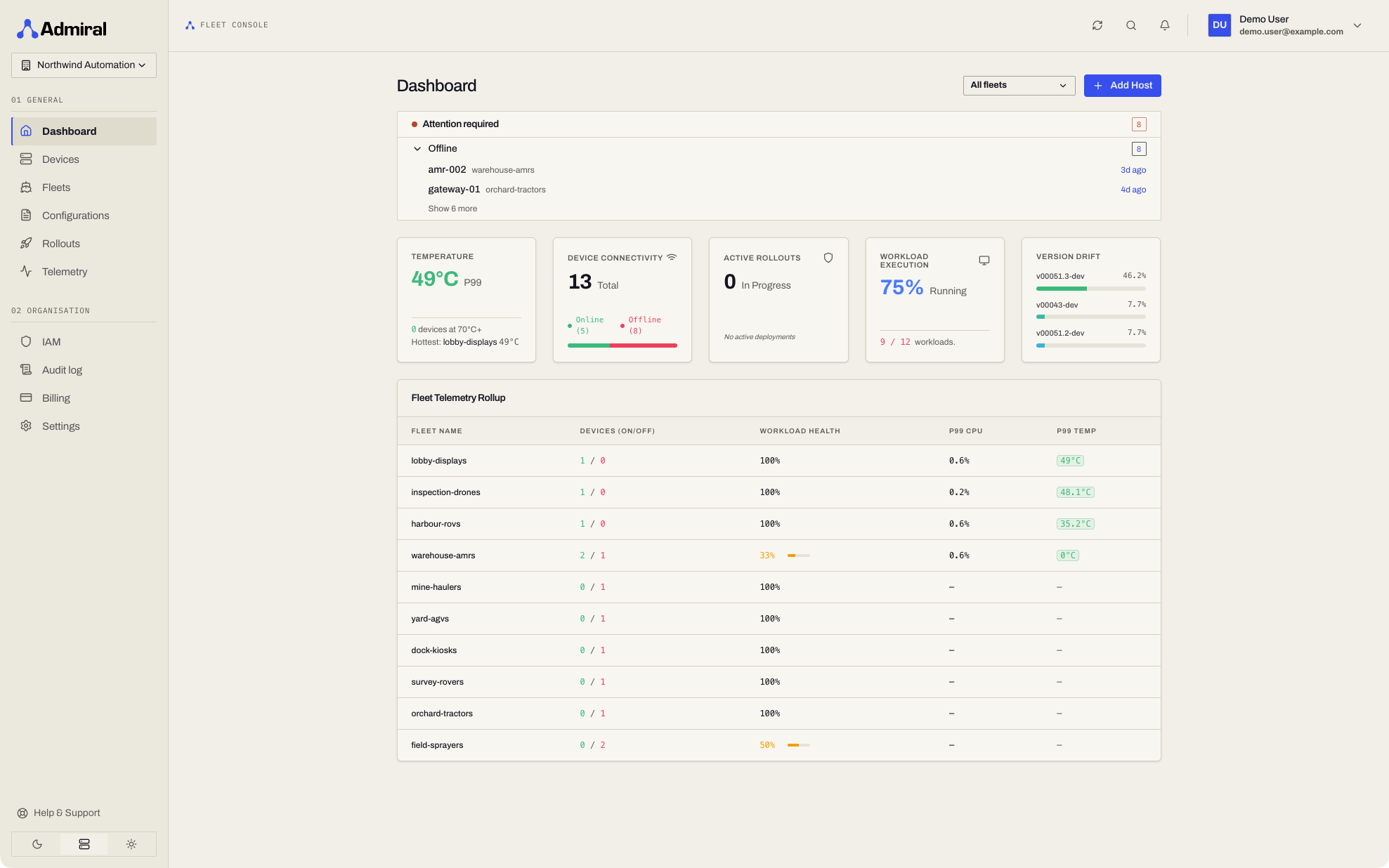
Built for Autonomous Machines & Distributed Hardware
Unlike traditional IoT systems that run on heavyweight desktop Linux distributions (requiring background daemons, systemd, and containerd), Admiral is engineered from the bare metal up to provide deterministic, zero-overhead fleet orchestration:
- The Admiral Manager & Immutable OS: A lightweight, memory-resident supervisor running from an immutable boot image. Total OS footprint is engineered for embedded hardware:
- ~30MB CPIO archive (including CPU microcode on x86)
- ~80MB Rootfs
- ~115MB Kernel Modules
- ~170MB Hardware Firmware Boots directly into an OCI container runtime with around 100MB of RAM usage (hardware dependent), and sub-10-second cold boots to workload ready on fast hardware, maximizing compute and memory headroom for robot navigation, SLAM, and on-chassis perception models.
- The Admiral Mesh: A unified TCP/UDP control fabric designed specifically for high-latency, low-reliability, and intermittent links. Edge machines maintain low-latency bidirectional command and telemetry routing across cellular networks and noisy industrial Wi-Fi with automated transport fallbacks.
- Dual-Slot A/B Rollback Safety: Field updates must never brick an autonomous vehicle in an inaccessible warehouse aisle or remote site. Full OS updates stage into an alternate partition slot with cryptographic verification. A new slot must boot and reconnect to the Admiral Mesh before the update is committed; otherwise the machine falls back to its last known-good slot automatically.
- Full Device Pass-through for Robotics & Vision: Enabling hardware access passes through the entire
/devtree into your workload container, providing immediate access to serial motor controllers, SocketCAN interfaces, cameras, LiDAR, and GPU accelerators without tedious path micro-management. - Copy-on-Write (CoW) Storage Engine: Persistent data partitions leverage an advanced Copy-on-Write (CoW) filesystem with transparent compression, persistent subvolumes, and instant atomic checkpoints that are completely immune to corruption from sudden power cuts.
- AirDetect™ Spatial Foot-Traffic Sensing: Turn every stationary kiosk, charging dock, or edge device into an anonymous physical traffic sensor. AirDetect passively clusters Bluetooth signals to measure foot traffic volume, dwell times, and customer proximity with zero cameras.
- Hardware Root of Trust & Disk Security: On hardware with a TPM 2.0 and UEFI Secure Boot, storage is encrypted with keys sealed to the Secure Boot state (PCR 7), recovery keys are escrowed automatically, and locked devices can be unlocked remotely. Every device reports its security posture, and fleets can declare the posture they require. See Device Security & Compliance.
- Fleet Telemetry & Alerting: Query metrics and historical logs across the whole fleet, and turn any query into an alert rule delivered in-app or by webhook. See Telemetry.
Vertically Integrated & Sovereign by Design
Admiral is not a userspace wrapper daemon sitting on top of a generic desktop Linux distribution. We compile and operate the entire infrastructure stack end-to-end:
- 100% Compiled from Source: Every binary that executes on the physical hardware—the bootloader, Linux kernel (mainline, or the silicon vendor's kernel tree where the SoC requires it, such as NVIDIA Jetson), init supervisor, and networking engine—is open-source compilable from source. There are zero opaque vendor blobs, zero third-party wrapper daemons, and zero unvetted package mirrors.
- Self-Hosted Cloud & Comms Fabric: The cloud control plane, real-time messaging fabric, telemetry ingestors, and analytics storage are built and operated end-to-end by Admiral.
- Byte-Level Provenance & Determinism: Every bit and byte that lands on an edge device has deterministic, verifiable cryptographic provenance. When an autonomous robot or critical machine operates in the field, you control the entire kernel-to-cloud execution path with zero black-box dependencies.
Quick Navigation
- Getting Started: New here? The Quickstart gets your first device online and ends with an example container. To set up headless devices from a browser, use Bluetooth provisioning; for batches, Auto-Provisioning.
- Core Concepts: Configurations, Fleets, Device Documents, Networking, and the Platform Boundary.
- Deploying & Updating: Rollouts, Maintenance Windows, A/B OS Updates, Private Registries, and Secret Files.
- Hardware & Robotics: Hardware Access, Robotics & ROS 2, GPU & NPU acceleration, Jetson Orin CUDA, and Unitree Robots.
- Operating Devices: Device Overview, Diagnostics, Telemetry, Alerts, and Bluetooth Field Service for offline devices on site.
- Security & Access: Device Security & Compliance, Account Security & Audit, Roles & Permissions, and Users, Groups & Access.
- Automation: The CLI & Workload Access, the REST API, Service Accounts, and Webhooks.
- Reference: The BLE Provisioning Protocol and the
/sys/admiralinterface.